Hindu Lucky Symbols: Ganesha, Lakshmi, Om, Swastika & More
Hindu lucky symbols arrived in Malaysia more than 1,500 years ago — well before the arrival of Islam in the archipelago — and remain a living visual language in Malaysian Indian homes, temples and businesses today. The Malaysian Indian community (roughly 6.6% of the population, per the 2020 census) is majority Tamil, with smaller Telugu, Malayalee, Punjabi and Sindhi communities, and each brought its own layer of Hindu folk practice. This page catalogues the most important Hindu lucky symbols a Malaysian reader is likely to encounter — Ganesha, Lakshmi, Om, the swastika, the rudraksha, and more — with proper context for each.
Two important clarifications up front. First, the swastika in Hindu tradition has nothing to do with its Nazi appropriation — the Hindu swastika is an ancient auspicious symbol that has been in continuous sacred use for over 3,000 years and is displayed prominently at Malaysian Hindu temples and Indian-owned businesses. Second, the Om is not merely a decorative motif — it is described in Hindu scripture as the primordial sound of creation, the original vibration of the universe, and chanting it is itself a spiritual practice.
Lord Ganesha — The Remover of Obstacles
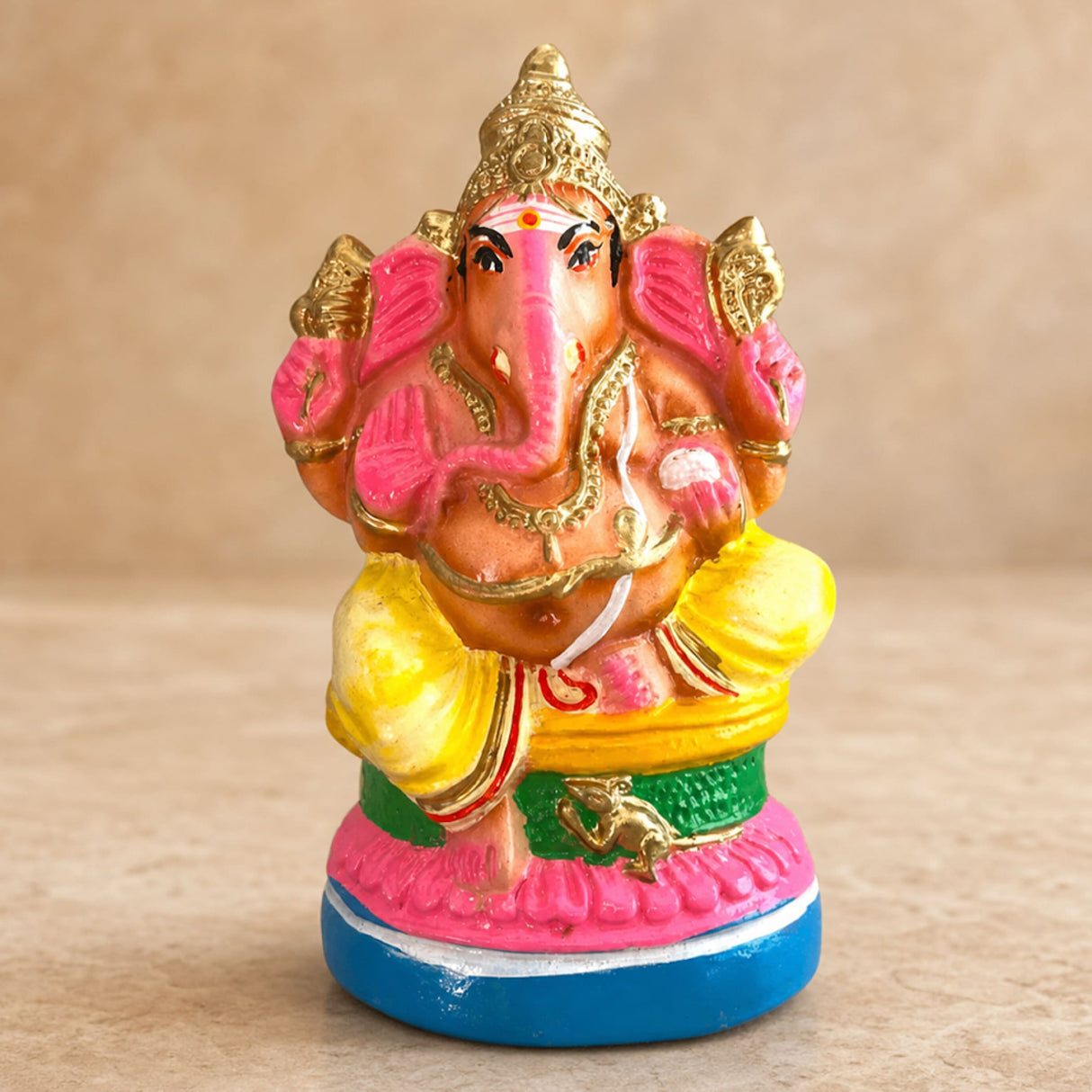
Ganesha, the elephant-headed son of Shiva and Parvati, is the most universally worshipped Hindu deity for luck and success. He is revered as the remover of obstacles (Vighnaharta) and the bringer of good fortune, wisdom, and new beginnings. In Hindu practice, no puja (ritual worship), no wedding, no business opening and no major life event begins without first invoking Ganesha — he clears the path so that the rest of the venture can proceed smoothly.
The iconography is dense with meaning. The elephant head represents wisdom and the ability to think big; the large ears listen more than they speak; the small eyes concentrate attention; the trunk can uproot a tree and pick up a single needle — representing adaptability. The broken tusk, in one legend, was used by Ganesha to write the Mahabharata as the sage Vyasa dictated it — representing sacrifice for the sake of knowledge. The mouse (or rat) at his feet is his vahana (vehicle), representing desire that has been brought under control.
In Malaysian Indian homes, a Ganesha statue is typically placed near the entrance or in the home's puja room. Malaysian Indian business owners — including restaurant owners, jewellers and textile merchants — almost universally display a Ganesha image near the cash register or above the shop entrance. The practice is so universal that Ganesha images are sold in every Malaysian Indian neighbourhood, from Brickfields in Kuala Lumpur to Little India in Penang.
Goddess Lakshmi — Wealth, Prosperity, Fortune
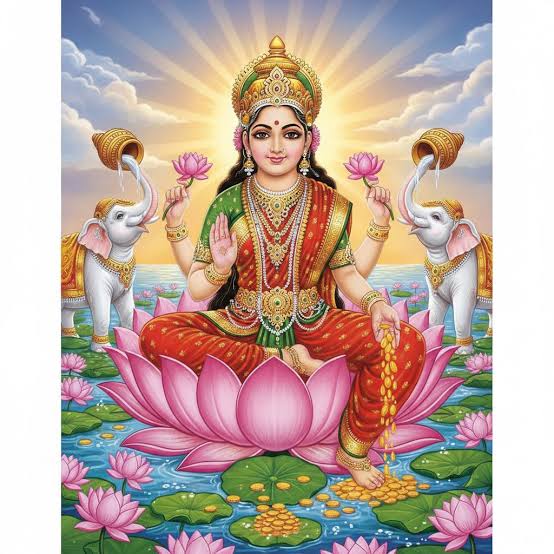
Lakshmi is the Hindu goddess of wealth, prosperity, good fortune and beauty, the beloved consort of Vishnu. According to Hindu scripture she rose from the churning of the ocean of milk (the Samudra Manthan), and her arrival in the world is celebrated annually at Diwali — the festival of lights — when Malaysian Indian families light rows of oil lamps at their doorsteps to invite her into their homes.
Her iconography is precisely coded. She is typically shown seated or standing on a blooming lotus (representing purity and spiritual unfolding). She has four arms. In two hands she holds lotus flowers; the third hand is in the varada mudra (the gesture of blessing and boon-giving); the fourth hand is in the abhaya mudra (the gesture of protection and fearlessness). Gold coins flow continuously from one of her lower hands — the visual representation of unending abundance. She is flanked by two elephants — sometimes by four, one at each corner — representing royal power and the waters of fertility.
For practical luck and wealth-attribution in a Malaysian Indian home, the Lakshmi image is placed in the north or east corner of the puja room. A Lakshmi image in the safe or cash box is believed to "lock in" wealth; some Malaysian Indian jewellers keep a small Lakshmi print inside the safe alongside their gold stock. The Friday Lakshmi puja — a weekly ritual of offering flowers, incense and a lit camphor flame to a Lakshmi image — is observed by many Malaysian Indian housewives.
The Om (Aum)
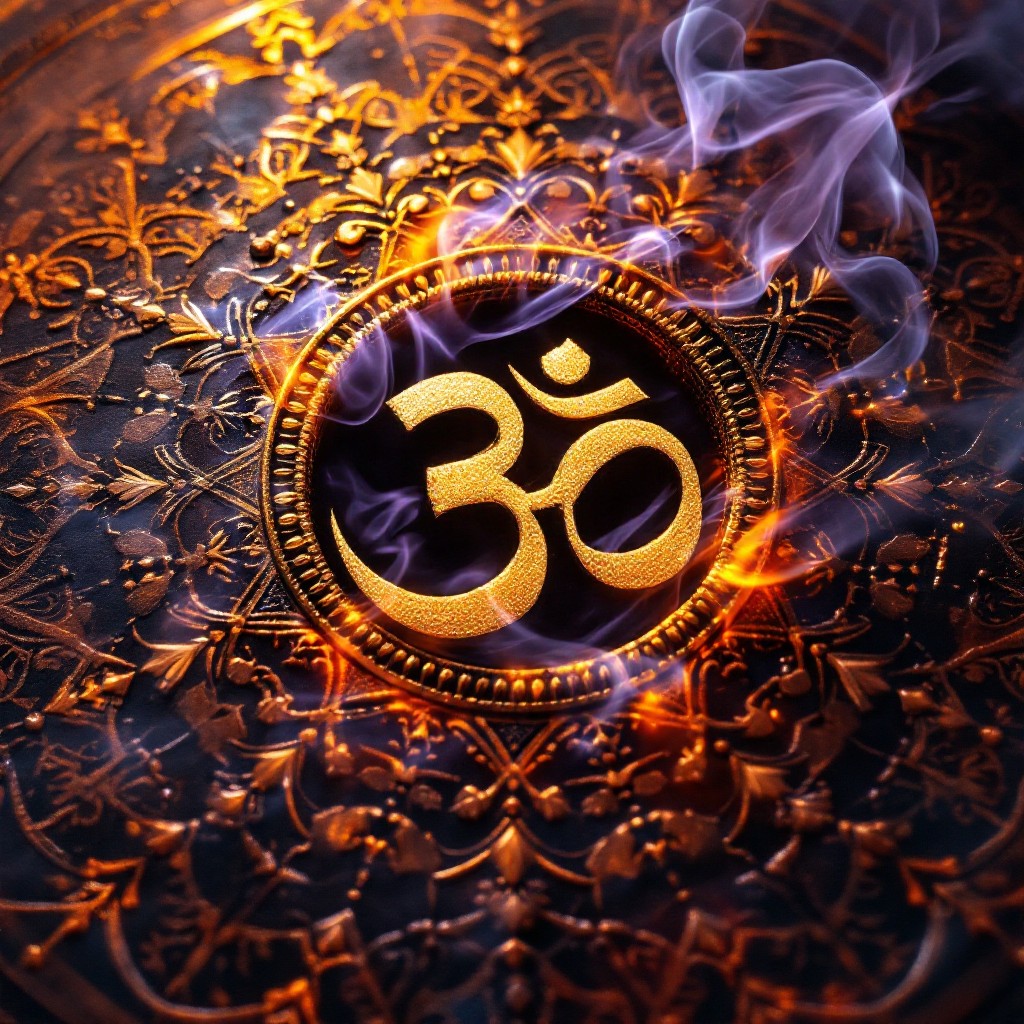
Om (sometimes written Aum) is the most sacred syllable in Hinduism, and its written form is the most important symbol in the religion. Hindu scripture defines Om as the primordial sound of creation — the original vibration of the universe. The Hindu American Foundation summarises it as representing both the unmanifest (nirguna) and manifest (saguna) aspects of God, which is why it is called pranava — "the cosmic sound".
The written Om symbol is composed of three curves, a semicircle, and a dot. The large lower curve represents the waking state (jagrat); the middle curve represents the dream state (swapna); the upper curve represents the state of deep sleep (sushupti). The semicircle represents maya — the illusion of the material world. The dot at the top represents turiya — the state of pure consciousness, the ultimate goal of spiritual practice. Together the symbol is a complete map of consciousness in a single ideogram.
For Malaysian Indian households, the Om symbol appears on doorways (drawn with turmeric paste or painted), on jewellery (especially pendants), on the cover of religious books and on the forehead of devotees after puja. Chanting "Om" three times at the start of any mantra is standard Hindu practice, and is the way every Malaysian Hindu puja begins.
The Swastika (Sathiya)
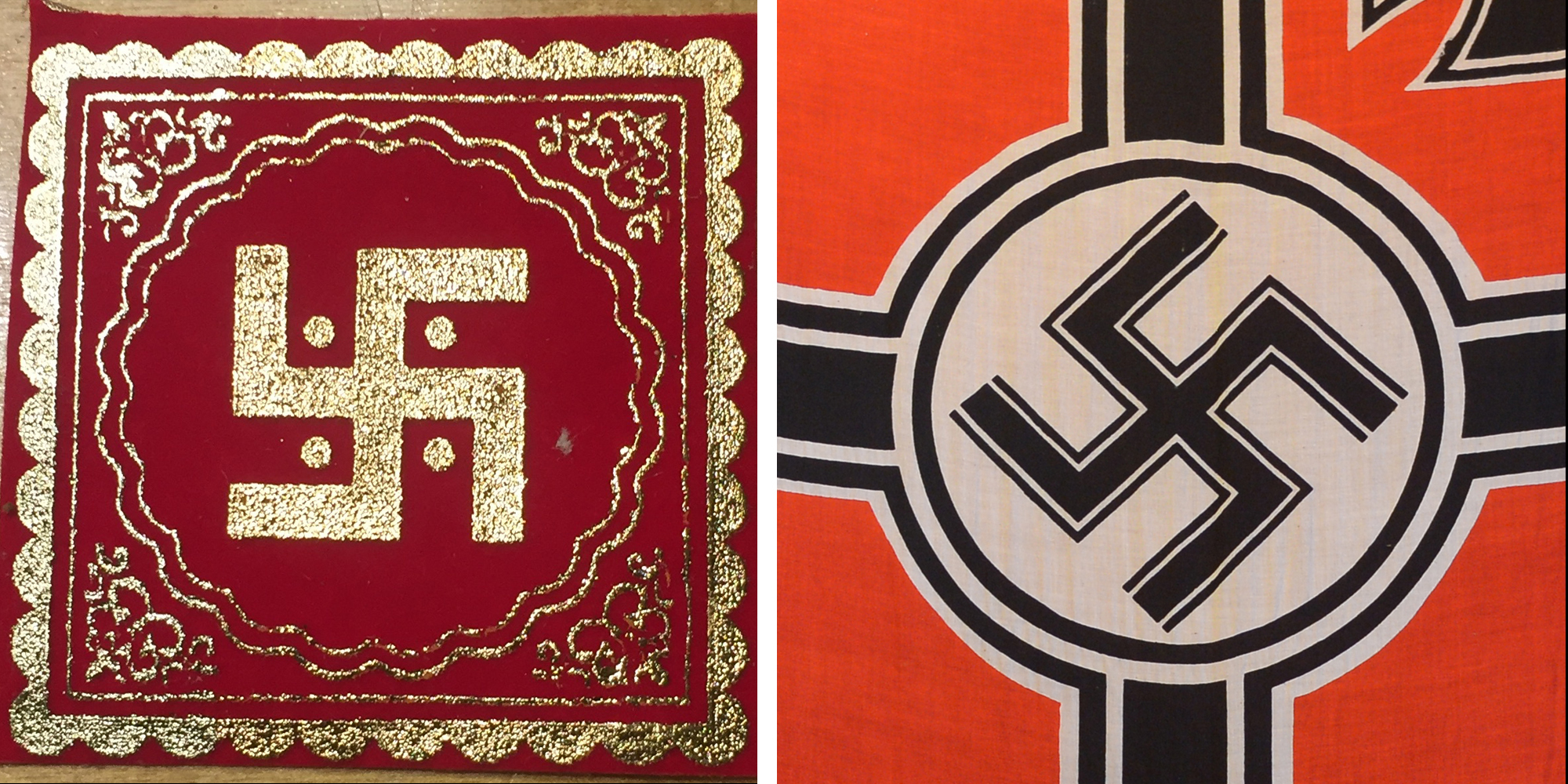
The swastika is one of the most important Hindu lucky symbols, and one of the most misunderstood in the West. The word comes from the Sanskrit su (good) and asti (it is) — literally, "that which is good". The symbol is a cross with its four arms bent at right angles, and in Hindu use the arms almost always point clockwise (the direction of the sun's apparent movement). It is associated with good luck, prosperity, and the cycle of rebirth, and is dedicated to Ganesha in some traditions.
The swastika has been used continuously in Hindu, Jain and Buddhist religious art for over 3,000 years. Its appropriation by the Nazi party in the 1920s — tilted 45 degrees and rotated — was a deliberate misappropriation of an ancient religious symbol, and the two should never be confused. The Hindu swastika is square, flat, often red or yellow on a contrasting background, and is drawn at the entrance of homes and temples during festivals, weddings, and the start of new ventures. It is also one of the 108 symbols on the feet of Vishnu as described in the Vishnu Purana.
In Malaysia, the Hindu swastika is freely displayed at temples, in Indian-owned businesses and on festival decorations. The Malaysian Hindu community, like Hindu communities worldwide, has actively campaigned to distinguish the sacred Hindu swastika from the Nazi symbol — an effort supported by the Hindu American Foundation and by interfaith groups in Malaysia.
Rudraksha Beads
The rudraksha is the seed of the Elaeocarpus ganitrus tree, traditionally associated with Shiva. The word comes from Sanskrit Rudra (a name of Shiva) and aksha (eye) — "Shiva's eye". According to legend, rudraksha trees grew where Shiva's tears fell to earth after he opened his eyes from a long meditation. The beads are strung into malas (prayer beads) of 108 plus one guru bead, and are worn by Shaivite Hindus — including many Malaysian Indian men — as a neck mala or a wrist bracelet.
The number of "faces" or mukhis on a rudraksha bead determines its believed property. A five-faced (panchamukhi) rudraksha is the most common and is worn for general well-being and peace. Other mukhis are rarer and more specific: one-faced for supreme consciousness, two-faced for harmony in relationships, six-faced for knowledge, seven-faced for wealth, eight-faced for health. The beads are believed to stabilise the body's electromagnetic field — a folk claim, not a medical one, but widely accepted in Hindu practice.
The Elephant with Trunk Up
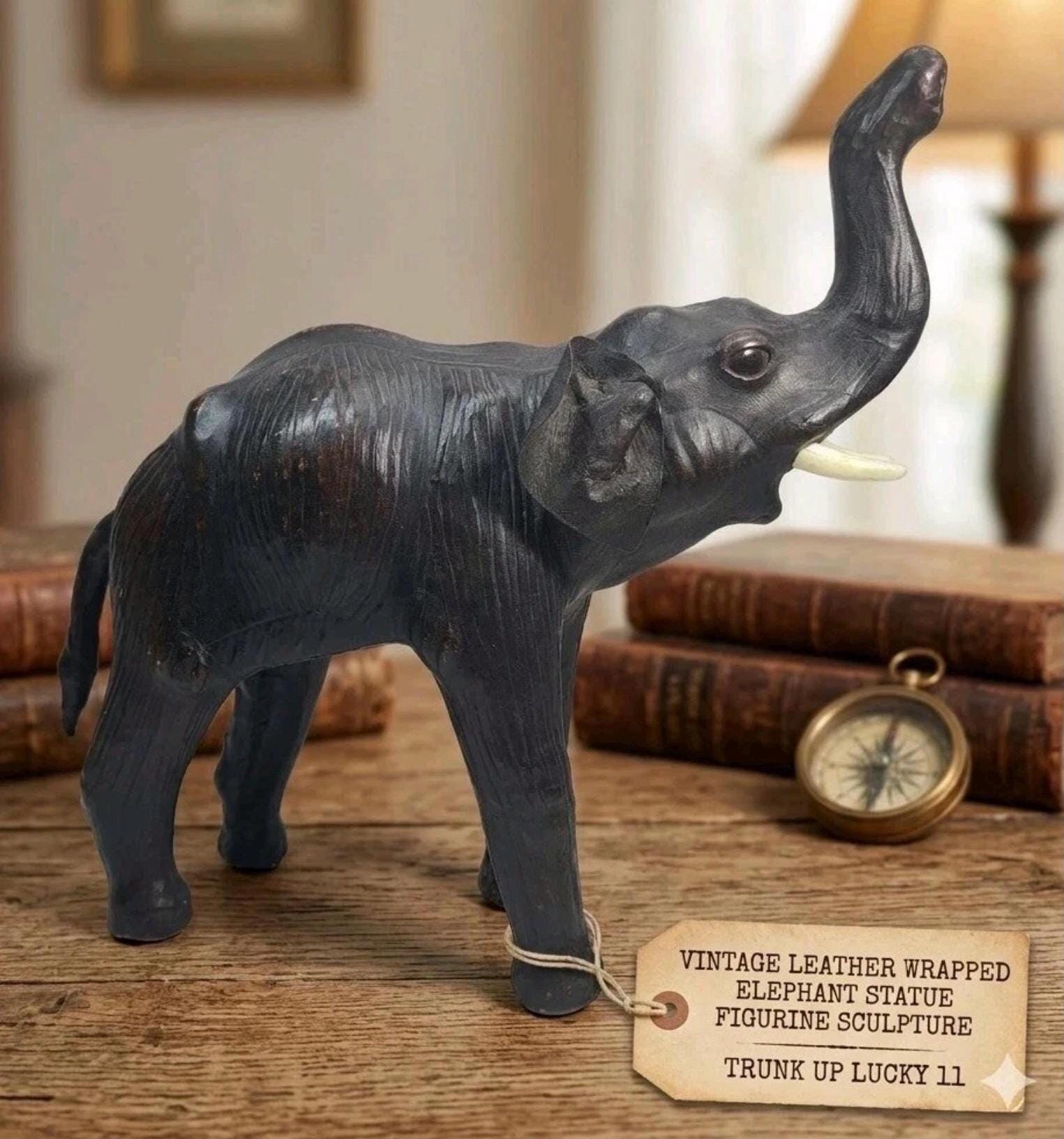
An elephant statue with its trunk raised upward is a popular good luck charm that originates in Ganesha worship but has been adopted far beyond Hindu communities. The belief is that a raised trunk showers luck, prosperity and good fortune over the household or business, while a downward-pointing trunk is said to be pushing luck away or "holding" it inside — opinions vary, but the consensus is that an upward trunk is the lucky one. In Malaysian Indian homes and Indian-owned businesses, a brass elephant family with raised trunks is often displayed near the entrance.
The Lotus (Padma)
The lotus is the most important plant symbol in Hinduism — the seat of Lakshmi, Saraswati and Brahma, and the visual metaphor for spiritual purity. The lotus grows in muddy water but its flower blooms above the surface untouched — the Hindu metaphor for the enlightened soul who lives in the world without being contaminated by it. In Malaysian Indian households, fresh lotus flowers are placed in the puja room on Fridays and during festivals; brass or silver lotus motifs decorate temple architecture; and the lotus is the most common motif on South Indian silk sarees sold in Little India.
The Kalasha — The Sacred Pot
The kalasha is a brass, copper or silver pot filled with water, topped with mango leaves and a coconut, used as a Hindu symbol of abundance and auspiciousness at every major ritual. A kalasha is placed at the entrance of a Malaysian Indian wedding hall, at the ground-breaking of a new building, and at the start of any major puja. It represents the universe in microcosm — the pot is the womb of creation, the water is the life-giving force, the leaves are the fertility of nature, and the coconut is the head of the divine.
Diwali — The Festival of Lights and Lakshmi
The most important festival for Malaysian Hindus is Diwali (also called Deepavali), celebrated nationwide as a public holiday. The core symbolic ritual of Diwali is the lighting of rows (deepa-avali) of small clay oil lamps (diyas) at doorsteps, windows and along the boundaries of the home. The lamps are lit to welcome Lakshmi into the home — she is believed to visit only houses that are brightly lit, clean, and fragrant with incense. Malaysian Indian families begin Diwali preparations weeks in advance with a thorough house-cleaning, the drawing of kolam (rice-flour patterns) at the entrance, and the purchase of new clothes and gold. The festival is the most visible Hindu lucky ritual in Malaysia — even non-Hindu Malaysian families often drive past Indian neighbourhoods at Diwali to admire the lights.
How to Use Hindu Lucky Symbols Practically
- For business openings, install a Ganesha image above the entrance and a Lakshmi image near the cash register. The Ganesha image faces outward to clear obstacles; the Lakshmi image faces inward to keep wealth inside.
- For a new venture or exam, chant the Ganesha mantra "Om Gam Ganapataye Namaha" 108 times on a rudraksha mala, the morning of the venture.
- For wealth at home, perform the Friday Lakshmi puja: clean the image, offer fresh flowers and a lit camphor flame, then walk through every room with the lit camphor.
- For Diwali, light at least one diya (oil lamp) at the main entrance of the home — this is the most universal Hindu luck ritual, observed even by homes that perform no other pujas.
Frequently Asked Questions
Is the Hindu swastika the same as the Nazi swastika?
No. The Hindu swastika is an ancient religious symbol, square and flat, used continuously in Hindu, Jain and Buddhist art for over 3,000 years. The Nazi swastika is a tilted 45-degree version misappropriated in the 1920s. They should never be confused. Malaysian Hindus display the Hindu swastika freely at temples and during festivals.
Why is Ganesha worshipped first?
In Hindu tradition, Ganesha is the remover of obstacles and the lord of beginnings. No puja, wedding, business opening or major venture is begun without first invoking him, because he is believed to clear the path for whatever comes next. He is also the patron of letters and learning, and is invoked before writing a document.
Which direction should a Lakshmi image face?
In a puja room, Lakshmi should face west (so the devotee faces east while praying to her). In a shop, Lakshmi is placed near the cash register with her face turned inward toward the shop's interior — the symbolism is that she keeps wealth circulating inside rather than letting it flow out.
What does the Om symbol actually represent?
Om is described in Hindu scripture as the primordial sound of creation — the original vibration from which the universe emerged. Its written form represents the four states of consciousness: waking, dream, deep sleep, and pure consciousness (turiya), plus maya — the illusion that separates the first three from the fourth.
Sources and Further Reading
- Hindu American Foundation — 5 Things to Know About Om
- Hindu American Foundation — Lakshmi: Goddess of Prosperity
- Wikipedia — Sanxing (Three Star Gods, for cross-reference)
- Wikipedia — List of lucky symbols
- Mindbodygreen — What Does The Om Symbol Mean?
Now read how Malaysian gamblers actually use these symbols.
Hindu symbols, Chinese gold ingots, Malay tangkal and Western horseshoes all show up in the pockets and wallets of Malaysian 4D buyers and casino-goers. Read our gambling luck guide to see how they're combined.